_Name%20Only%20with%20SoCal%20Black.png)
No Map, Just a Chainsaw


When our avocado orchards were first laid out in the 1960s, labor was relatively inexpensive and there were more people walking the rows, tending trees and checking irrigation. Today, like most farms, we rely more on equipment. We use UTVs to move around the ranch, not because I don't like to walk (I do), but because you can cover a lot more ground and carry tools, irrigation supplies, and whatever else you discover you need along the way.
The problem is that the orchard wasn't designed for that. Our original roads and trails were often four or five rows apart, about 100 feet. That is a long way to look when you are trying to find a malfunctioning sprinkler or inspect an irrigation line buried under a bed of leaves. Over the past few years, I have been adding intermediate paths so we can drive closer to every row and keep a better eye on the orchard.
Making a path sounds simple, but it isn't. First, I walk the proposed route, many times, looking at trees, slopes, irrigation lines, drainage, and where the path will eventually connect. Once I decide on the best route, I spend hours with my chainsaw cutting it in. Depending on the terrain, our tractor operator comes behind me to grade it.
Last weekend, I cut a new path through one of our best avocado blocks. As I worked, I kept thinking about the quote:
“Do not go where the path may lead; go instead where there is no path and leave a trail.”*
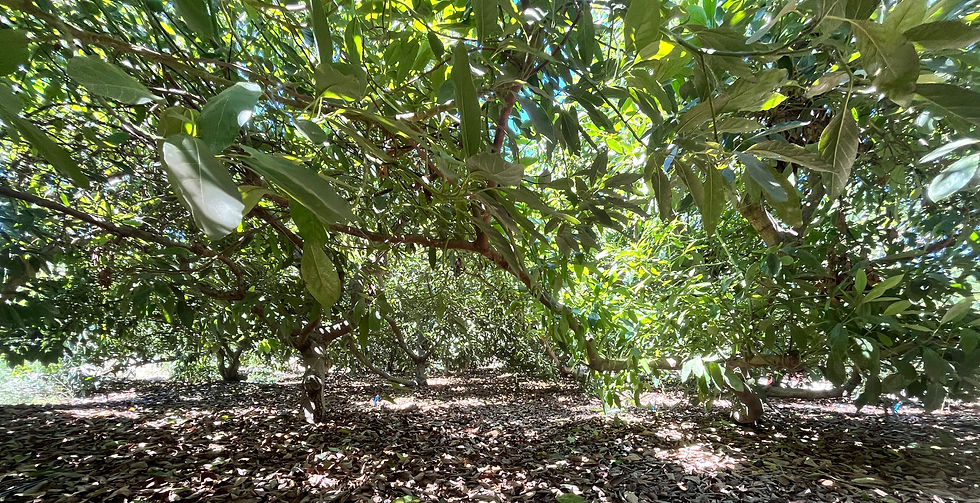

It felt particularly appropriate because cutting the trail is actually the easy part. Deciding which trail to cut is much harder. That is true of far more than roads through orchards. One of the greatest challenges in farming is knowing whether the things we are doing, and investing our time and money in, are the right ones. We are planting new avocado varieties, replacing irrigation systems, changing the way we manage trees, diversifying what we grow, and trying new ways of bringing what we produce directly to customers. Some of those decisions will take years before we really know whether they were good ones.
When doubt wiggles in, I remind myself of something much simpler: the old system is not sustainable. Standing still isn't actually an option. So we study, ask questions, experiment, make the best decisions we can with the information we have, and keep moving forward. Sometimes you follow an established road. Sometimes you have to cut a new one.
And, of course, sometimes nature has other plans entirely. Last week, something destroyed two of my five pumpkin “patches.” We assume it was an animal, but whatever did it ripped apart the beds while leaving the pumpkin plants themselves behind. There were no obvious tracks. We historically haven't had wild pigs. A bear would certainly be strong enough, but why would it be grubbing (using the original definition) through my pumpkin beds? It happened during the afternoon, making raccoons, skunks, and opossums seem less likely. Even the deer, who are normally delighted to eat our avocado leaves, apparently ignored those in favor of whatever interested our mystery visitor in the beds.

I was sad and disappointed for about five minutes. Then I remembered my aunt and uncle's tomatoes. Decades ago, they planted and tended a few acres of tomatoes in a remote part of the backcountry. Just getting water to the site was an accomplishment. They spent months caring for the plants and eventually had a beautiful crop that was nearly ready to harvest. Then a horde of locusts arrived and devoured it. The whole crop.
I heard that story as a child, and roughly 60 years later, I found myself standing beside my torn-up pumpkin beds remembering it. Suddenly, losing two patches of pumpkins I had grown mostly for fun didn't seem quite so tragic. More importantly, I was reminded that disappointment, uncertainty, and starting over aren't new parts of rural living. They may be among its oldest traditions.
Perhaps that is another kind of path we inherit in agriculture. Not a road someone cut through an orchard, but a trail of stories left by the people who farmed before us: crops that failed, weather that didn't cooperate, animals that ate things they weren't supposed to eat, ideas that worked, ideas that didn't, and people who got up the next morning and started again.
There are also people along the way who remind us why it is worth continuing. Recently, at a funeral, a stranger approached me and said, “You're the one writing about agriculture. Thank you.” That same week, someone emailed me, “People are so hungry to know where their food comes from, to experience something ‘real.’”
They were passing comments, but they buoyed me. I had been wondering whether these missives and musings about farming, family, avocados, successes and failures mattered. Apparently, to at least a few people, they do. Sometimes a few words of encouragement arrive at exactly the moment you need them.
Maybe that is what I was really thinking about as I walked back and forth through the avocado trees deciding where to put that new road. Growing trees asks us to make decisions whose results we may not know for years. It asks us to invest in plants we hope will produce, infrastructure we hope will last, and ideas we hope will work. There is never a sign pointing toward the correct path.
And when I look around the ranch, I realize that uncertainty is everywhere. Something is being planted, something else is growing, something is ready to harvest, and something we expected to harvest has disappeared overnight. We are watching new crops develop, trying new ideas, making plans for next year, and occasionally discovering that weather, wildlife, markets, trees, and mysterious pumpkin-bed marauders have plans of their own.
That is farming. You make plans without the luxury of knowing exactly how they will turn out. You learn from what worked, adjust when something didn't, remember the people who farmed before you, and appreciate the people cheering you on today. Then you make the best decision you can and keep going.
We cannot always know whether the path we choose is the right one. Sometimes there isn't a path at all. Fortunately, I really like using my chainsaw.
*Muriel Strode, “Wind-Wafted Wild Flowers”


Comments